Measure visibility in AI answers,
not just rankings on Google.
Connect your site audit, content planning and publishing workflow with observations of how your brand appears in AI answers.



 coverage varies by integration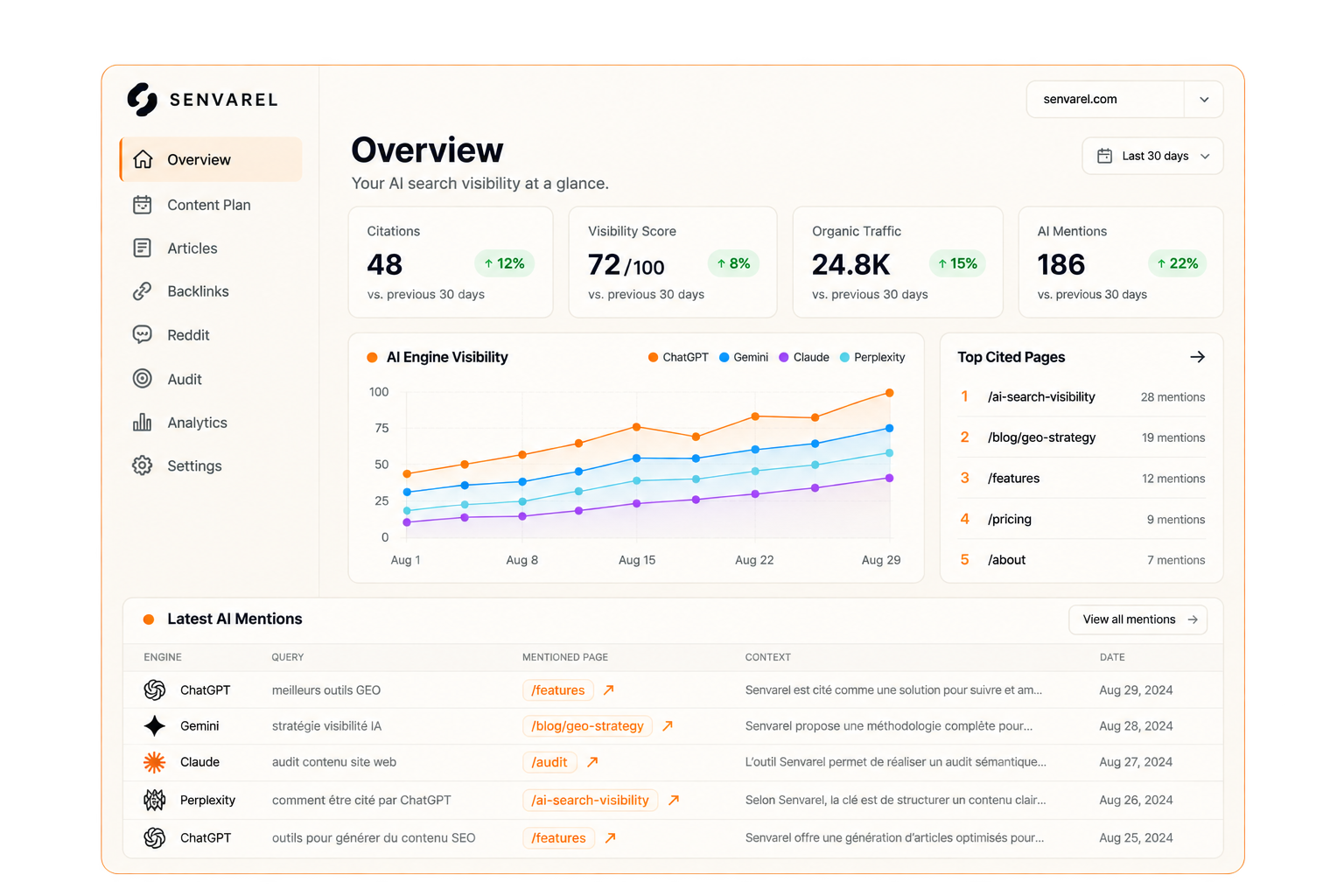
A clearer page.
A claim you can inspect.
How to review brand visibility in AI answers
Senvarel helps teams inspect brand mentions, answer context and source links where capture is supported.
- Observe
- The complete answer and its query
- Distinguish
- Mention, recommendation and citation
- Qualify
- Available sources and capture limits
No guaranteed AI rankings or citations.
A content illustration, not a measured before/after result. No AI response or citation gain is implied.
From audit to action,
a connected workflow.
Keep the observation, content decision and follow-up together. Explore what each stage contributes.
Start with a GEO audit- 01
DETECTGEO Audit
Review strategic queries and available answers. Keep brand mentions, recommendations and captured sources separate.
OBSERVATION BRIEFQuery → Answer → Brand role → Available sourcesA missing or failed provider response is not zero visibility. - 02
UNDERSTANDContent Signal Plan
Turn the questions and gaps you observe into a content brief: which page to create, enrich or investigate next.
CONTENT BRIEFAudience question / Existing page / Evidence to addPriorities depend on the evidence collected, not a guaranteed ranking formula. - 03
ACTGeneration & review
Generate a draft, review its claims and quality, then publish according to your configured workflow and available CMS integration.
ILLUSTRATIVE REVIEWDraft → Quality review → Publication decisionA draft that needs review should remain distinct from a published page. - 04
LEARNVisibility Monitoring
Return to collected answers to review presence, prominence and source links where capture is supported.
FOLLOW-UP OBSERVATIONSame query / New answer / Context to compareSource capture supports Perplexity when sources are returned. Other integrations show Not supported.
Build a page worth
reading and referencing.
Explore the six areas to review in your content. They guide the work; they do not reveal a model’s hidden ranking rules.
Make every part
of the page useful.
Senvarel — AI Search Visibility software
Brand, category and purpose are stated together.
Select a review area to inspect its role in the example.
Make the brand, product and category explicit. Use consistent names and factual descriptions across the pages you control.
Build useful coverage around the questions your audience asks. Look for missing explanations before creating more pages.
Organize the page with descriptive headings, concise definitions and useful lists or tables. Add relevant schema where appropriate.
Make factual claims traceable. Separate original evidence from interpretation, and link to the sources that support the explanation.
Review relevant prompts across available integrations. Interpret each answer alongside its engine, query and execution status.
Revisit pages when facts, products or audience questions change. Use collected observations to guide review priorities.
One content foundation.
Two views of discovery.
Search results and AI answers expose different signals. Review both without assuming that a ranking guarantees a citation.
Explore AI Visibility| What you review | SEO | GEO |
|---|---|---|
| Surface | Search result pages | Generated answers and recommendations |
| Observation | Impressions, clicks and search positions | Brand presence, answer role and available source links |
| Context | Query, page, country and device | Query, engine, answer and execution status |
| Shared work | Useful, accessible and well-structured content | Useful, accessible and well-structured content |
| Limits | Search positions vary across contexts | Answers vary; not every integration supports source capture |
Surface
- SEO
- Search result pages
- GEO
- Generated answers and recommendations
Observation
- SEO
- Impressions, clicks and search positions
- GEO
- Brand presence, answer role and available source links
Context
- SEO
- Query, page, country and device
- GEO
- Query, engine, answer and execution status
Shared work
- SEO
- Useful, accessible and well-structured content
- GEO
- Useful, accessible and well-structured content
Limits
- SEO
- Search positions vary across contexts
- GEO
- Answers vary; not every integration supports source capture
Neither discipline guarantees placement. Source availability and engine coverage remain explicit.
Choose your next step.
Frequently Asked
Questions
The workflow, measurement limits and what to expect.
What is Generative Engine Optimization?
Generative Engine Optimization (GEO) is the practice of making content easier to discover, understand and reference in AI-generated answers. It combines clear entities, useful source pages, structured content and measurement of observable answers.
How is GEO different from traditional SEO?
SEO focuses on visibility in search results. GEO adds the study of brand mentions, recommendations and available source citations inside generated answers. The two practices share foundations such as useful content, technical accessibility and clear site structure.
Which AI platforms does Senvarel monitor?
Senvarel's internal visibility index has integrations for ChatGPT, Gemini, Claude and Perplexity. Coverage depends on provider configuration and successful execution. Structured source capture in that index supports Perplexity when sources are returned; the other three index adapters do not currently capture structured sources. Public checker integrations use a separate provider pipeline.
How long before GEO shows results?
There is no guaranteed timeframe. AI answers vary with the query, engine, available sources and time of measurement. Review collected observations over time rather than treating publication as a promise of citations or recommendations.
Does GEO replace SEO?
No. GEO complements SEO by adding visibility inside generated answers to the measurement workflow. Search positions, brand mentions and citations are separate observations; none guarantees the others.
Can Senvarel work on any CMS?
Publishing depends on the connectors available for your account and the configuration of your site. Confirm your CMS integration before enabling automatic publication. Content generation, review and publication remain distinct stages.